
Over the past few weeks, in Part I: Foundations of Evolution, we explored the forces that shaped life on Earth. We discovered how drifting continents reshaped habitats, how Charles Darwin explained evolution through natural selection, why “survival of the fittest” is often misunderstood, and how modern genetics has refined our understanding of evolution.
But evolution doesn’t just explain how populations change over time. It also answers another important question:
How does one species become two?
The answer lies in speciation, the evolutionary process by which one ancestral species gives rise to two or more distinct species. Every plant, animal, fungus, and microorganism alive today exists because, at some point in evolutionary history, an ancestral population split into separate lineages that gradually evolved into different species.
In this article, we’ll explore what defines a species, how reproductive isolation prevents gene flow, and the different pathways through which new species arise.
What is a Species?
A species is the basic unit of biological classification. In simple terms, it is a group of organisms that share common characteristics and can produce fertile offspring. While this definition seems straightforward, defining a species is surprisingly complex, and biologists have debated it for decades.
According to the Biological Species Concept, proposed by evolutionary biologist Ernst Mayr, a species consists of populations whose members actually or potentially interbreed in nature and produce fertile offspring.
One important point to remember is that appearance alone does not define a species. Organisms may look remarkably similar yet belong to entirely different species, while members of the same species can sometimes appear very different.
Like every scientific concept, the Biological Species Concept has its limitations.
- It cannot be applied to asexual organisms such as bacteria because they do not reproduce sexually.
- Some closely related species occasionally produce hybrids, making species boundaries less distinct.
- Ring species, such as the Ensatina salamanders of California, demonstrate gradual changes around a geographic barrier. Neighboring populations can interbreed, while populations at opposite ends of the range cannot.
- It is impossible to determine whether extinct fossil species could have interbred, making the concept difficult to apply to ancient organisms.
Gene Flow: The Glue That Holds a Species Together
Gene flow is the movement of genes between populations through reproduction. As long as individuals continue to interbreed, they exchange genetic material and remain genetically similar. Gene flow therefore acts as a force that keeps populations united as a single species.
However, once gene flow is interrupted, populations begin evolving independently. Over many generations, these isolated populations accumulate genetic differences that may eventually prevent them from interbreeding altogether, giving rise to new species.
Reproductive Isolation: The First Step Towards Speciation
The interruption of gene flow is known as reproductive isolation. It occurs when two populations can no longer successfully produce fertile offspring because of geographic, behavioural, physiological, or genetic barriers.
Once reproductive isolation is established, each population follows its own evolutionary path.
A classic example is the Eastern Meadowlark and Western Meadowlark.
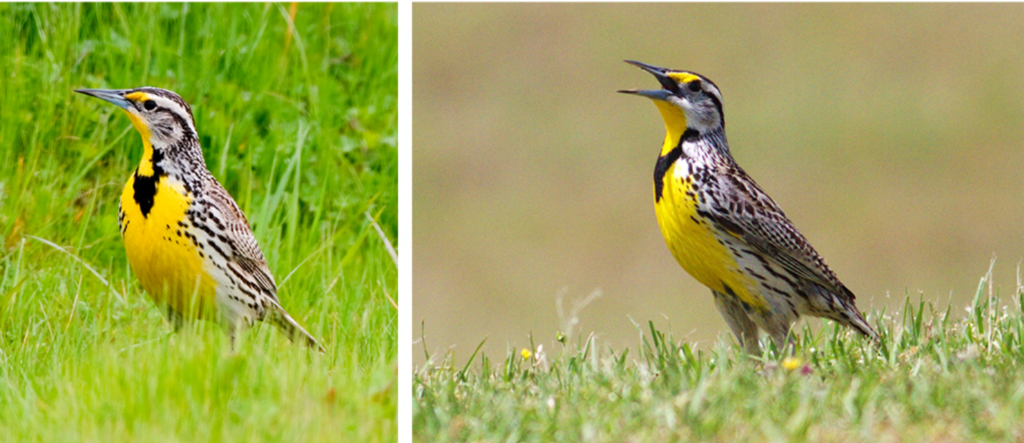
Although these birds look remarkably similar and their geographic ranges overlap, they do not interbreed because their courtship songs are different. Females respond only to the songs of males from their own species, creating a strong behavioral barrier to reproduction.
Prezygotic Barriers
Prezygotic barriers prevent mating or fertilization before a zygote is formed.
Temporal (or Habitat) Isolation
Closely related species reproduce at different times or occupy different habitats, preventing them from meeting.
Behavioural Isolation
Differences in courtship displays, mating calls, or other behaviors prevent successful mating.
Example: Female fireflies respond only to the flashing patterns of males belonging to their own species.
Mechanical Isolation
Differences in reproductive structures prevent successful mating.
Gametic Isolation
Even if mating occurs, sperm and egg may be biologically incompatible, preventing fertilization.
Example: The sperm of one sea urchin species cannot fertilize the eggs of another.
Postzygotic Barriers
Postzygotic barriers act after fertilization has occurred.
Hybrid Inviability
The embryo fails to develop properly or dies before reaching adulthood.
Hybrid Sterility
Hybrids survive but are unable to reproduce.
Example: The mule, produced by crossing a horse and a donkey, is typically sterile.
Hybrid Breakdown
Although first-generation hybrids may be fertile, later generations become weak or infertile.
Haldane’s Rule
When only one sex of a hybrid is absent, rare, or sterile, it is usually the heterogametic sex (for example, males in mammals).
Together, these reproductive barriers maintain species boundaries and allow populations to evolve independently.
The Four Major Types of Speciation
1. Allopatric Speciation
Allopatric (allo = other, patric = place) refers to the formation of new species through geographic isolation.
A physical barrier such as a mountain range, river, ocean, or continental drift separates a once-continuous population. Since individuals on either side can no longer interbreed, mutations, natural selection, and genetic drift gradually cause them to diverge into separate species.
Examples:
- Continental drift separating populations over millions of years
- Darwin’s finches on the Galápagos Islands
- Kaibab and Abert’s squirrels separated by the Grand Canyon
2. Sympatric Speciation
Sympatric (sym = same, patric = place) occurs when new species arise without geographic separation.
Although populations occupy the same geographic area, differences in habitat preference, food source, mating behaviour, or chromosome number reduce gene flow and eventually produce reproductive isolation.
Examples:
- Apple maggot flies shifting from hawthorn trees to apple trees
- Polyploidy in flowering plants
3. Parapatric Speciation
Parapatric (para = beside, patric = place) occurs when neighbouring populations occupy adjacent habitats with different environmental conditions.
There is no complete physical barrier, but individuals usually mate only with nearby neighbours. Over time, different selection pressures reduce gene flow and eventually produce distinct species.
Examples:
- Heavy-metal tolerant grasses growing near abandoned mines
- Populations distributed along environmental gradients
4. Peripatric Speciation
Peripatric (peri = near, patric = place) occurs when a small population becomes isolated at the edge of a much larger population.
Because the isolated population contains relatively few individuals, founder effects and genetic drift have a much stronger influence. Combined with natural selection, these forces can rapidly produce new species.
Examples:
- Island colonization by birds or insects
- Small founder populations isolated after dispersal to newly formed islands
Why Speciation Matters
Speciation is the process that generates Earth’s extraordinary biodiversity.
Without speciation:
- Every organism would still belong to a single ancestral population.
- Ecosystems would lack their incredible diversity.
- Evolution would have no way to create new branches on the tree of life.
Every species from bacteria and flowering plants to blue whales and humans exists because, somewhere in its evolutionary history, an ancestral population split into two. Speciation is the process that continually adds new branches to the evolutionary tree of life.
In the next article of the Evolution Series – Part II: From Species to Humans, we’ll explore sexual selection and discover why evolution sometimes favours beauty, elaborate displays, and even seemingly disadvantageous traits over simple survival.
Thanks for sharing!