
Last two weeks, we explored the cell. But, where did the very first cell come from?
How did lifeless chemicals eventually give rise to every bacterium, plant, animal, and human being on Earth?
Join me on this fascinating journey to the origin of the first cell.
Perhaps one of the biggest questions in biology is:
Where did life come from?
Many researchers believe that life had a chemical origin, where simple inorganic compounds gradually gave rise to complex organic molecules.
Earth Before Life
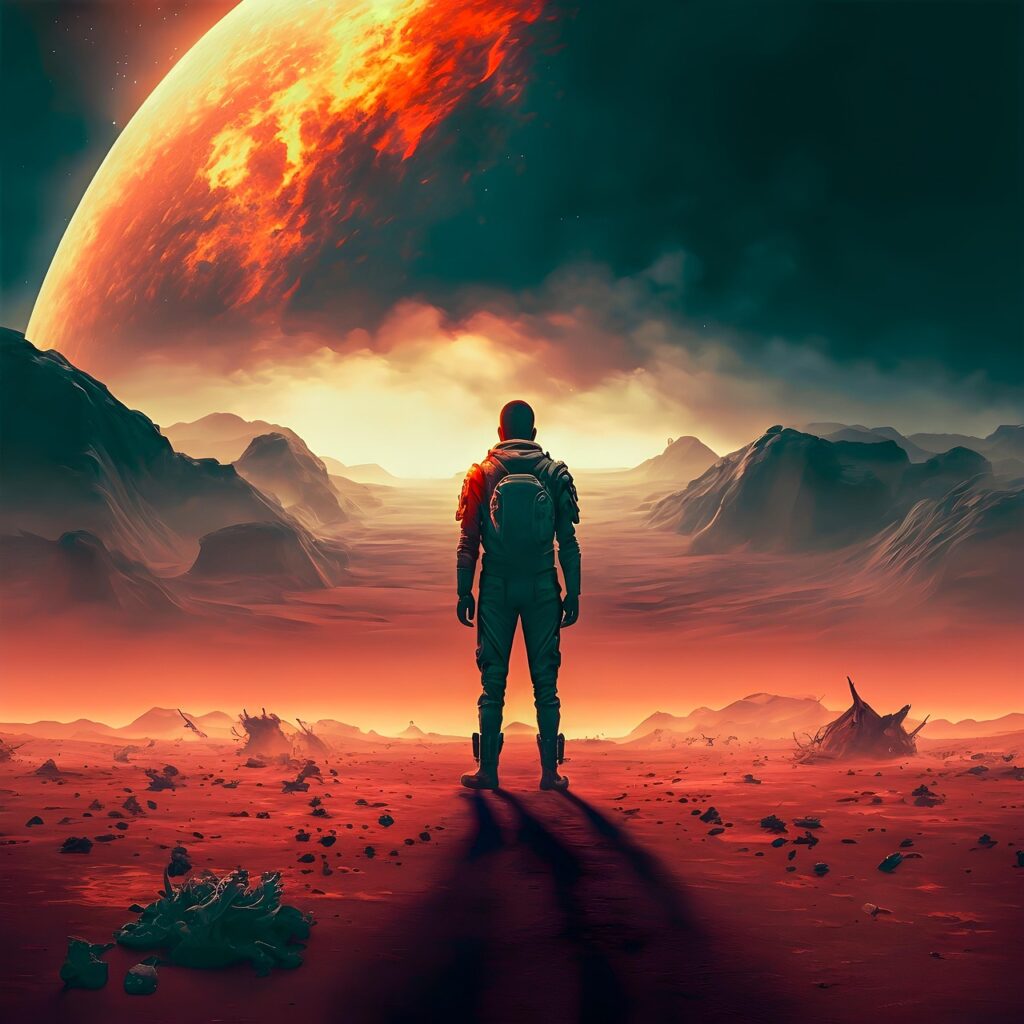
The early Earth looked very different from the planet we know today. It was characterized by:
- High temperatures
- A reducing atmosphere rich in methane and ammonia
- No free oxygen
- Frequent volcanic eruptions
- Vast oceans filled with dissolved chemicals, often referred to as the primordial soup
But would you believe that this hostile environment may have given rise to all life on Earth? Scientists propose that simple inorganic molecules, through a series of chemical reactions, gradually formed increasingly complex organic compounds, ultimately leading to the origin of life.
Earth as a Giant Chemical Laboratory
Alexander Oparin and J.B.S. Haldane independently proposed that life originated in the primordial oceans of early Earth.
According to the Oparin-Haldane hypothesis, simple organic molecules accumulated in the oceans and underwent chemical reactions driven by energy from lightning and ultraviolet radiation from the Sun. The absence of oxygen helped prevent these newly formed molecules from being rapidly destroyed. Over time, these reactions produced increasingly complex compounds, eventually paving the way for life.
Stages in the Chemical Origin of Life
1. Miller-Urey Experiment: Formation of Simple Organic Molecules
To test the Oparin-Haldane hypothesis, Stanley Miller and Harold Urey recreated conditions believed to resemble early Earth. They passed electric sparks through a mixture of water vapor, methane, ammonia, and hydrogen.
After a week, the apparatus contained amino acids: the building blocks of proteins. This landmark experiment demonstrated that organic molecules could indeed form under prebiotic conditions.
Did You Know?
The Miller-Urey experiment did not create life. It only produced some of the building blocks of life, such as amino acids. Creating a living cell from non-living chemicals remains one of science’s greatest challenges.
2. Formation of Complex Macromolecules
As amino acids, nucleotides, and other simple organic molecules accumulated in the primordial oceans, they likely combined to form larger and more complex molecules. Amino acids may have given rise to proteins, while nucleotides eventually formed nucleic acids such as RNA and DNA.
3. Formation of Protocells
The next step may have been the appearance of protocells: simple cell-like structures capable of growth and division but lacking the complexity of modern cells.
4. Coacervates and Microspheres
Experiments have shown that certain organic molecules can spontaneously assemble into membrane-like structures in water. These structures, known as coacervates and microspheres, resemble early cell membranes and may represent an important step toward the formation of the first true cells.
5. The RNA World
One of the most influential ideas in origin-of-life research is the RNA World Hypothesis. RNA is unique because it can both store genetic information and catalyze chemical reactions.
The discovery of ribozymes (RNA molecules with catalytic activity) strengthened the idea that early life may have relied on RNA before the evolution of DNA and proteins.
6. Natural Selection Begins
Once self-replicating molecules emerged, natural selection could begin to act. Molecules that replicated more efficiently or survived longer would become more common, gradually increasing biological complexity and eventually leading to the first living cells.
Meet LUCA
Every living organism on Earth from bacteria to blue whales to humans can trace its ancestry back to a common ancestor. Scientists refer to this organism as LUCA (Last Universal Common Ancestor).
LUCA is believed to have lived approximately 3.5- 4 billion years ago and was probably a simple single-celled organism. Although LUCA was not the first form of life, it is thought to be the ancestor from which all modern life evolved.
The Mystery Isn’t Solved Yet
Despite decades of research, two major questions remain unanswered:
- How did the first self-replicating RNA molecules arise?
- How did simple protocells transform into fully functional living cells?
The origin of life remains one of biology’s greatest mysteries.
We started our journey by exploring the cell. But before we can fully understand how cells work, we must first ask how the very first cell appeared.
Over the coming weeks, we’ll continue exploring evolution, speciation, human origins, and the remarkable journey that eventually led to us.
Great read, thanks for sharing!