
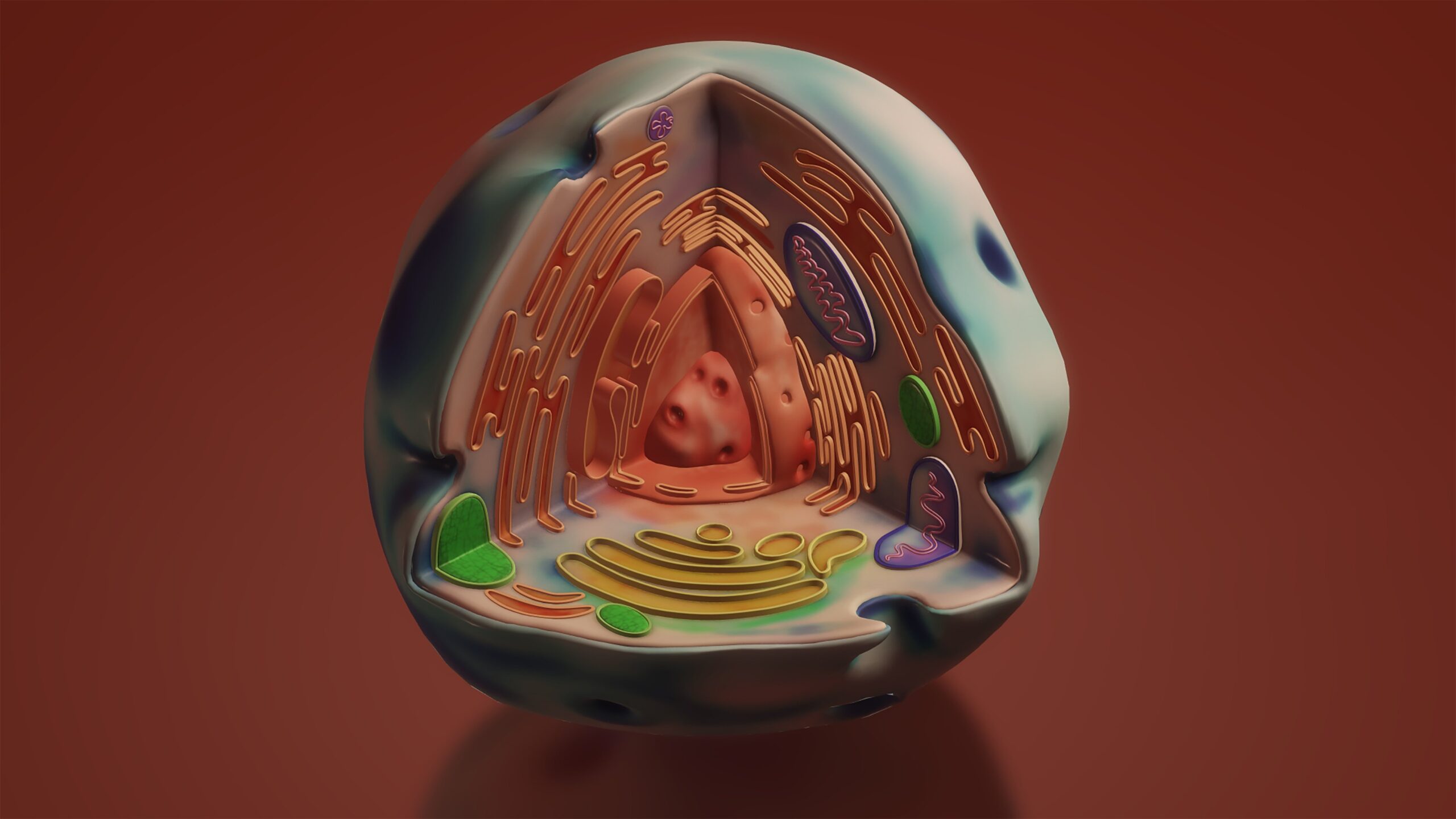
Imagine a complex network of highways running throughout your city, transporting raw goods, manufacturing products, and delivering them to their destinations. Inside every eukaryotic cell, the endoplasmic reticulum (ER) performs a similar role.
The endoplasmic reticulum is the largest and one of the most important membrane-bound organelles in eukaryotic cells. It forms an extensive network of interconnected membranes that extends throughout the cytoplasm.
What is the Endoplasmic Reticulum?
The endoplasmic reticulum is a continuous network of flattened sacs (cisternae) and branching tubules enclosed by a single membrane.
Its membrane is highly folded and convoluted, giving it a maze-like (labyrinthine) appearance. These folds greatly increase the surface area available for various biochemical reactions.
Unlike many organelles, the ER is continuous with the outer membrane of the nuclear envelope, creating a direct connection between the nucleus and the cytoplasm. This arrangement allows newly synthesized molecules to be efficiently transported throughout the cell.
The ER membrane encloses an internal cavity known as the ER lumen (cisternal space).
Compartments of the ER
The ER divides the intracellular environment into two distinct compartments:
- Luminal compartment : the space inside the ER (ER lumen)
- Extraluminal compartment : the surrounding cytoplasm
This separation allows the ER to carry out specialized biochemical reactions while maintaining a controlled internal environment.
Structural Components of the ER
The endoplasmic reticulum consists of three interconnected membrane-bound structures.
1. Cisternae
- Flattened, sac-like membrane structures
- Arranged in parallel stacks
- Usually studded with ribosomes
- Predominantly associated with the rough ER
2. Tubules
- Highly branched, tube-like structures
- Lack ribosomes
- Characteristic of the smooth ER
3. Vesicles
- Small spherical or oval membrane-bound sacs
- Detached from the ER
- Transport newly synthesized molecules to other organelles, particularly the Golgi apparatus.
Types of Endoplasmic Reticulum
Based on the presence or absence of ribosomes, the ER is classified into two types.
Rough Endoplasmic Reticulum (RER)
The rough endoplasmic reticulum appears rough because ribosomes are attached to its cytoplasmic surface. Since ribosomes synthesize proteins, the RER serves as the primary site for the production of proteins that are secreted, inserted into membranes, or delivered to lysosomes.
The RER is usually located close to the nucleus because it receives messenger RNA (mRNA) directly from the nucleus for protein synthesis.
Major functions of the Rough ER
- Protein synthesis
- Protein folding into the correct three-dimensional structure
- Post-translational modifications such as glycosylation
- Quality control of newly synthesized proteins
- Packaging proteins into transport vesicles for delivery to the Golgi apparatus
Protein Quality Control: The Unfolded Protein Response (UPR)
Not every newly synthesized protein folds correctly. Misfolded or unfolded proteins can accumulate inside the ER lumen and interfere with normal cellular functions.
To prevent this, cells activate a protective mechanism known as the Unfolded Protein Response (UPR).
During UPR:
- Protein synthesis is temporarily reduced.
- Molecular chaperones such as BiP help proteins fold correctly.
- Misfolded proteins are identified and degraded through ER-associated degradation (ERAD).
If the damage is too severe and normal function cannot be restored, the cell undergoes programmed cell death (apoptosis) to prevent further damage.
So, the rough ER not only manufactures proteins but also ensures that only properly folded proteins leave the organelle.
Smooth Endoplasmic Reticulum (SER)
Unlike the rough ER, the smooth endoplasmic reticulum lacks ribosomes, giving it a smooth appearance. It is composed mainly of interconnected membrane tubules and specializes in lipid metabolism rather than protein synthesis.
Major functions of the Smooth ER
- Synthesis of phospholipids
- Cholesterol synthesis
- Steroid hormone synthesis (in endocrine cells)
- Detoxification of drugs and harmful chemicals
- Calcium ion storage
- Carbohydrate metabolism, including glycogen breakdown (glycogenolysis)
In liver cells, the smooth ER contains enzymes that detoxify alcohol, drugs, and various toxins.
Sarcoplasmic Reticulum: A Specialized Smooth ER
In skeletal and cardiac muscle cells, the smooth ER is modified into a specialized structure called the sarcoplasmic reticulum.
Its primary function is to store and release calcium ions (Ca²⁺), which regulate muscle contraction and relaxation.
Transport from the ER to the Golgi Apparatus
After proteins and lipids are synthesized, they are packaged into transport vesicles that bud off from the ER.
These vesicles carry their cargo to the Golgi apparatus, where the molecules undergo further modification, sorting, and packaging before reaching their final destination inside or outside the cell.
Thus, the ER and Golgi apparatus together form the cell’s secretory pathway.
Other Important Functions of the Endoplasmic Reticulum
Besides protein and lipid synthesis, the ER performs several additional functions.
- Mechanical support- Its extensive membrane network provides structural support and helps maintain the shape of the cell.
- Intracellular transport- The ER functions as the cell’s internal transport system, allowing the movement of proteins, lipids, and other molecules between different cellular regions.
- Isolation of metabolic reactions- The ER lumen creates a specialized environment where biochemical reactions occur independently from the cytoplasm.
- Formation of cellular membranes- The ER contributes membrane components for the nuclear envelope, Golgi apparatus, lysosomes, and transport vesicles.
- Lipoprotein formation- The smooth ER combines proteins and lipids to produce lipoproteins required for intracellular transport.
- Electrical impulse conduction- In muscle cells, the sarcoplasmic reticulum rapidly transmits signals by regulating calcium movement, enabling efficient muscle contraction.