
You tell yourself to stop thinking about it.
But the thought comes back. Louder.
Obsessive Compulsive Disorder (OCD) isn’t about being neat or organized. And it isn’t a matter of weak willpower. It’s what happens when the brain’s alarm system refuses to switch off.
Behind the relentless thoughts lies a complex network of neural circuits and chemical messengers, a system designed to detect danger.
So why don’t OCD thoughts simply stop? Let’s look at what neuroscience reveals.
What are compulsive thoughts, really?
Obsessive Compulsive Disorder, as the name suggests, is characterized by uncontrollable, recurring thoughts (intrusive thoughts) along with repetitive behaviors to reduce distress. These thoughts are often unwanted. They may involve the need for perfect symmetry, fear of germs, intense fear of harming others, or forbidden thoughts.
Unlike normal ‘worrying’, they are more frequent and intense, making them difficult to dismiss. They feel urgent and threatening. To suppress the anxiety, the brain pushes the person towards repetitive actions or mental rituals. But the relief is temporary, and the cycle starts again.
The obsession-anxiety-compulsion loop
OCD follows a predictable pattern.
Obsession and Anxiety– Intrusive thoughts (obsessions) trigger intense anxiety and distress. The brain interprets it as a threat to be resolved.
Compulsion– To relieve the anxiety, the individuals perform repetitive actions known as compulsions- checking, counting, washing hands, etc. This gives some temporary relief.
But the brain learns something dangerous. So, the next time the brain is anxious due to an intrusive thought (which almost always recurs), they perform these compulsive acts. This is the vicious cycle of obsession-anxiety-compulsion.
Now, let’s understand what happens inside the brain during an OCD loop.
The brain circuit that gets stuck
Researchers point towards a specific brain circuit: Cortico-Striato-Thalamo-Cortical (CSTC). This circuit, in individuals without the condition, is responsible for voluntary movement, habit formation, and reward-based behavior. It also plays a role in filtering thoughts. Hyperactivity in this particular loop is involved in the pathophysiology of OCD.
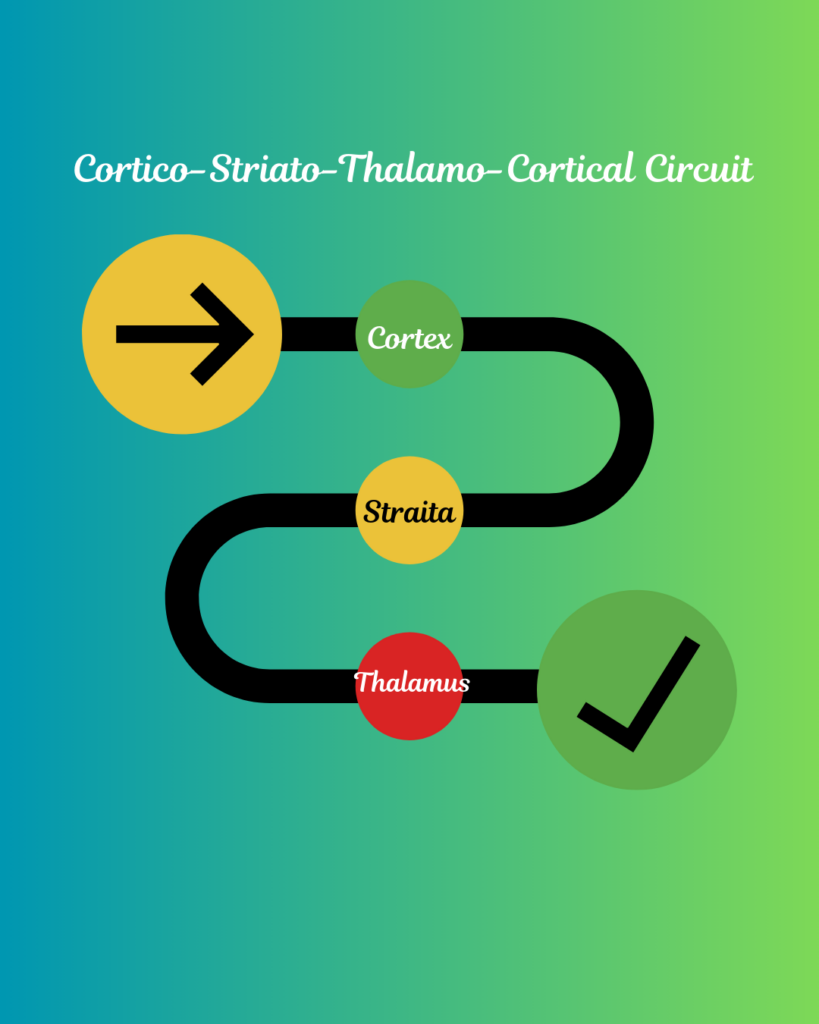
It is a closed-loop system starting with the cortex that sends excitatory signals to the striatum. The striatum communicates to the Thalamus through the basal ganglia, sending inhibitory or excitatory feedback to the cortical areas. In OCD, this particular circuit gets hyperactivated and goes on a vicious, chronic loop. The imbalance in inhibition and excitation results in repetitive behaviors and is a classic sign of OCD.
Neuroimaging studies have also shown hyperactivity in key regions, including the orbitofrontal cortex, the anterior cingulate cortex, and the basal ganglia.
These regions together contribute to the feeling that something is ‘not right’, driving the urge to correct it through compulsive actions.
Neurotransmitters and chemical imbalance
Brain circuits do not function in isolation. They rely on chemical messengers known as neurotransmitters to transmit signals between neurons. One of the most studied neurotransmitters in OCD is serotonin. It plays a role in mood regulation, emotional processing, sleep, and anxiety. More importantly, it helps modulate activity within the CSTC circuit.
When serotonergic signaling is disrupted, communication within this circuit becomes inefficient. Signals that should be regulated may persist longer than necessary.
However, OCD cannot be explained by “low serotonin” alone. Emerging research suggests that other neurotransmitters particularly dopamine and glutamate also influence the CSTC pathway.
An imbalance in how these chemicals regulate excitation and inhibition may contribute to the persistent thought- behavior loop seen in OCD. Rather than a simple chemical deficiency, OCD appears to involve dysregulated communication within interconnected brain networks.
Understanding OCD changes the narrative.
It shifts the question from
“Why can’t I just stop?” to
“Why is my brain sending this signal?”
OCD is not a lack of discipline. It is not about being organized. It is a hyperactive brain circuit that refuses to switch off.
The intrusive thought feels urgent because the brain flags it as a threat.
The compulsion feels necessary because it briefly reduces that alarm.
If a thought feels real simply because your brain keeps repeating it, how many other “truths” are just signals waiting to be understood?
Comment your thoughts.
That was an interesting read, thanks.