
Classification of Organisms by Cell Structure
All living organisms are made up of cells. Based on their cellular organization, they can be broadly classified into two categories:
1. Prokaryotes
- Lack a true nucleus.
- Do not possess membrane-bound organelles.
- Genetic material is housed in a nucleoid instead of a nucleus.
- Usually unicellular organisms.
Example: Bacteria
2. Eukaryotes
- Possess a distinct membrane-bound nucleus that houses the genetic material.
- Contain membrane-bound organelles.
- May be unicellular or multicellular.
Example: Humans
Now that we have divided organisms into prokaryotes and eukaryotes, let’s focus on the eukaryotes. These organisms are further classified into major kingdoms, each with unique characteristics.
Protista
- Mostly unicellular organisms.
- Examples: Amoeba, algae.
Fungi
- Mostly multicellular (exception: yeast).
- Cell wall is made of chitin.
- Heterotrophic (cannot make their own food).
Plantae
- Multicellular.
- Cell wall is made of cellulose.
- Autotrophic (can make their own food through photosynthesis).
Animalia
- Multicellular.
- Heterotrophic.
- Lack a cell wall and possess only a cell membrane.
So far, we have classified organisms based on their cell structure. But what does the inside of a cell actually look like? To answer that, we first need to understand two terms that are often confused: cytosol and cytoplasm.
Cytosol
The cytosol is the aqueous, jelly-like fluid present within the cell membrane.
Cytoplasm
The cytoplasm consists of the cytosol along with all the cell organelles, excluding the nucleus.
In simple terms:
Cytoplasm = Cytosol + Organelles (except nucleus)
The cytoplasm contains approximately 70% water. It acts as a solvent and medium for diffusion. Despite its high water content, it contains numerous dissolved proteins that give it a jelly-like consistency.
It also contains:
- Ions such as sodium, potassium, and calcium.
- Small molecules.
- Large water-soluble molecules.
- Its pH ranges between 7 and 7.4.
Functions of the Cytoplasm
- Hosts important biochemical pathways such as glycolysis, gluconeogenesis, and protein synthesis.
- Facilitates transport of molecules within the cell.
- Participates in cell signalling by transmitting signals from the cell membrane to the nucleus.
The cytoplasm is not simply a bag filled with molecules and organelles. In eukaryotic cells, different functions are separated into specialized compartments. This organization is known as cell compartmentalization.
Cell Compartmentalization
Cell compartmentalization is a hallmark of eukaryotic cells. Unlike prokaryotes, eukaryotes possess membrane-bound organelles that separate different cellular functions.
But why is compartmentalization necessary?
1. Separation of Incompatible Reactions
Many reactions occur simultaneously within a cell. Some of these reactions could interfere with each other if they occurred in the same space.
For example, lysosomes contain hydrolytic enzymes capable of digesting cellular components. Their membranes prevent these enzymes from damaging other parts of the cell.
2. Maintenance of Specialized Environments
Different organelles maintain different internal conditions.
- Lysosomes require an acidic environment for digestion.
- Peroxisomes maintain oxidative conditions for their functions.
3. Increased Efficiency
Concentrating enzymes and substrates within a small space increases reaction rates and improves efficiency.
4. Increased Surface Area
Some organelles possess highly folded membranes.
For example, mitochondria contain folds called cristae that greatly increase surface area, enhancing ATP production.
Major Cellular Compartments
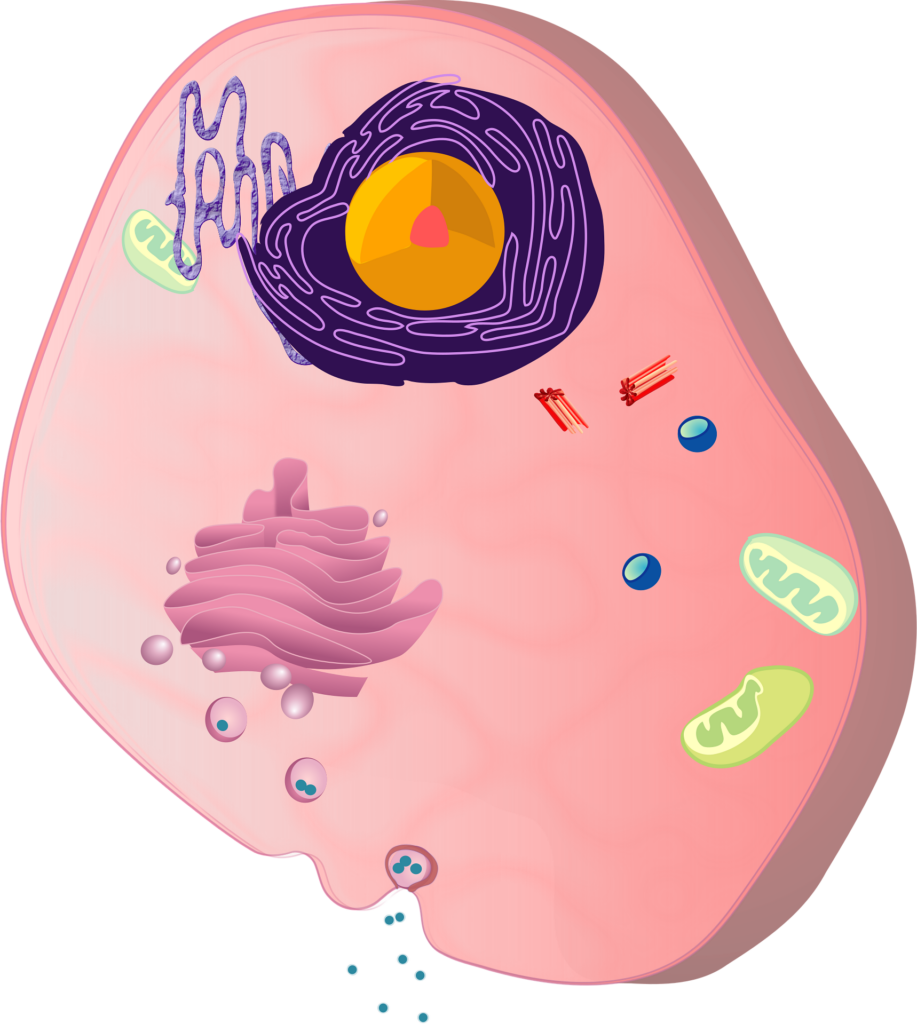
1. Nucleus
- Houses genetic material.
- Regulates gene expression.
- Directs protein synthesis.
2. Endoplasmic Reticulum (ER)
Rough ER
- Studded with ribosomes.
- Responsible for protein synthesis and folding.
Smooth ER
- Synthesizes lipids.
- Detoxifies chemicals.
3. Golgi Apparatus
- Sorts, modifies, and packages proteins and lipids.
- Directs them to their appropriate destinations.
4. Mitochondria
- Site of ATP production.
- Often referred to as the powerhouse of the cell.
5. Lysosomes and Peroxisomes
- Involved in waste disposal and detoxification.
- Break down cellular debris and harmful by-products.
6. Chloroplasts
- Found in plant cells.
- Responsible for photosynthesis.
Since these organelles are physically separated from one another, materials are transported between them through the endomembrane system using transport vesicles.
Now that we have explored the cell’s internal organization, let’s look at the structure that separates the cell from its external environment: the cell membrane.
Cell Membrane and Permeability
The cell membrane forms the boundary between the cell and its surroundings.
Functions of the Cell Membrane
1. Selective Permeability
Allows essential nutrients to enter the cell while permitting waste products to leave.
2. Protection
Protects the cell and its internal components from the external environment.
3. Cell Signalling
Contains receptors that respond to hormones and neurotransmitters.
4. Structural Support
Helps maintain cell shape and integrity.
To understand how the membrane performs these functions, scientists proposed the Fluid Mosaic Model.
Fluid Mosaic Model
According to this model, the cell membrane is a dynamic structure composed of lipids, proteins, cholesterol, and carbohydrates.
1. Phospholipid Bilayer
The basic framework of the membrane.
Phospholipids are amphiphilic molecules, meaning they contain:
- A hydrophilic (water-loving) head.
- A hydrophobic (water-fearing) tail.
They arrange themselves into a bilayer with the hydrophobic tails tucked away from water.
2. Proteins
Membrane proteins act as:
- Transporters
- Channels
- Receptors
They help move substances across the membrane and facilitate communication between cells.
3. Cholesterol
Located within the phospholipid bilayer.
Its primary function is to maintain membrane fluidity and stability across different temperatures.
4. Carbohydrates
Attached to proteins and lipids on the cell surface.
They function as identification markers and help cells recognize one another.
The cell membrane is therefore not a rigid barrier but a dynamic structure that regulates transport, communication, protection, and cellular organization.
Thanks for sharing