
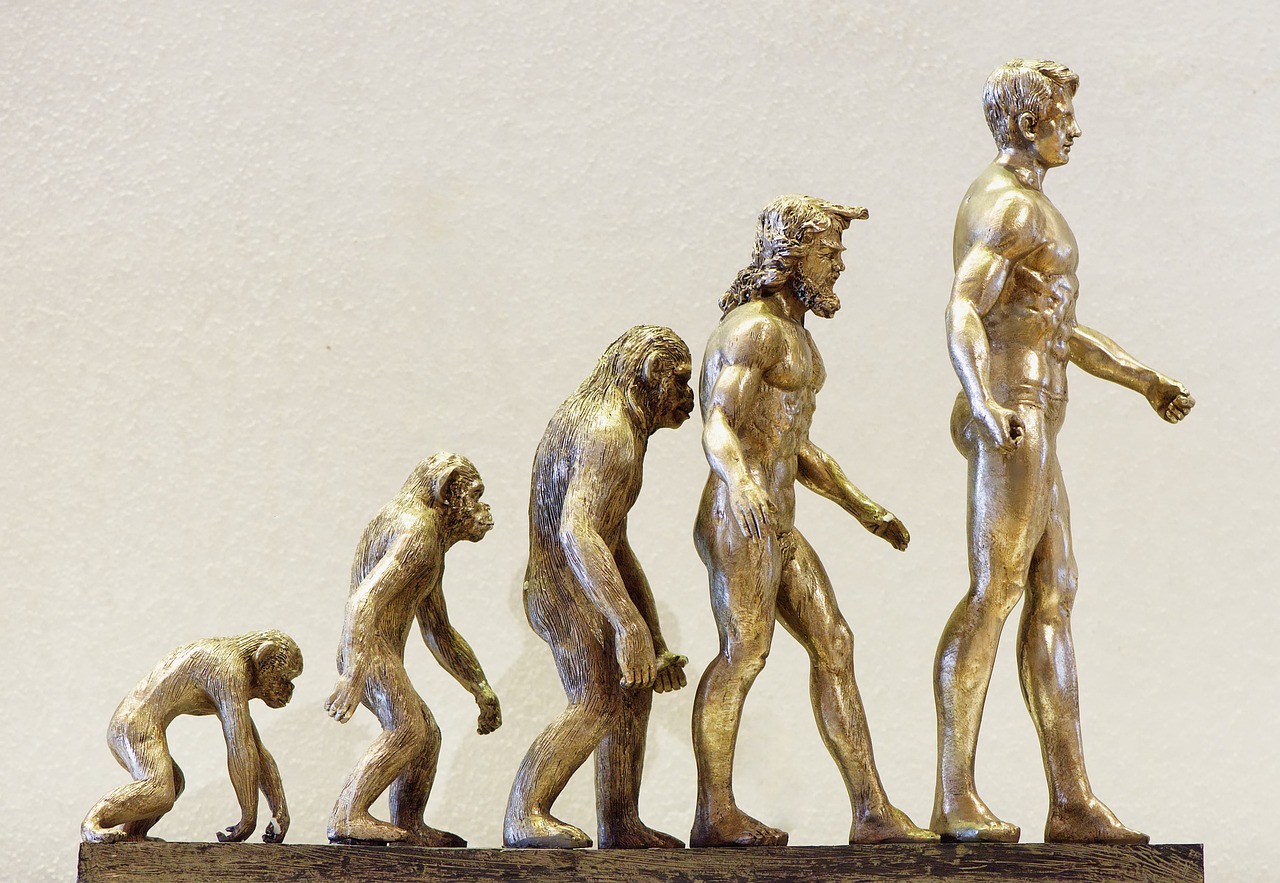
Why do some organisms survive while others disappear? How do entirely new species arise from a common ancestor? And what is the force that drives evolution?
For centuries, scientists believed that species were fixed and unchanging. Although early thinkers recognized that organisms could transform over time, no one could explain how these changes occurred.
That changed in 1859, when Charles Darwin introduced the theory of natural selection. It was a revolutionary idea that provided the mechanism behind evolution. More than 165 years later, it remains one of the cornerstones of modern biology, supported by evidence from genetics, fossils, ecology, and molecular biology.
In this article, we’ll trace the evolution of evolutionary thought: from early naturalists to Darwin and explore how natural selection transformed our understanding of life on Earth.
The pre- Darwanian Era
Before Charles Darwin published his famous theory, scientists had already begun questioning whether species were truly fixed and unchanging.
The idea that organisms could gradually transform over time was known as transmutation of species or transformism. Although these early ideas lacked a convincing mechanism, they laid the foundation for Darwin’s revolutionary explanation of evolution through natural selection.
Evolutionary Thoughts Before Darwin
Pre-18th Century: Species Were Considered Fixed
The dominant belief for centuries was that every species had been created exactly as it exists today and remained unchanged.
Carl Linnaeus (1707–1778)
Carl Linnaeus developed the modern system of biological classification, organizing living organisms into hierarchical groups such as kingdom, class, order, family, genus, and species.
Although his classification system revealed similarities among organisms, Linnaeus believed that species were fixed entities rather than branches of a common evolutionary tree.
Late 18th Century: Nature Was Not Static Extinction Changed Scientific Thinking
The work of Georges Cuvier the founder of paleontology, demonstrated that many organisms preserved as fossils no longer existed.
This challenged the long-held belief that nature was perfect and unchanging.
Fossils Revealed Earth’s History
Geologist William Smith observed that undisturbed rock layers contained fossils in a consistent sequence.
Older rock layers contained older and generally simpler fossil forms.
Younger layers contained more recent organisms.
This principle, known as faunal succession, allowed scientists to determine the relative ages of rocks and fossils.
Early 19th Century: Lamarck’s Theory of Evolution
The first comprehensive evolutionary theory was proposed by Jean-Baptiste Lamarck in 1809.
Lamarck believed that organisms continuously adapted to their environment through two mechanisms.
a. Use and Disuse
Body parts that were frequently used became stronger and more developed, whereas structures that were rarely used gradually degenerated.
For example, Lamarck suggested that giraffes stretched their necks to reach higher leaves, causing their necks to become progressively longer during their lifetime.
b. Inheritance of Acquired Characteristics
Lamarck proposed that characteristics acquired during an organism’s lifetime were passed on to its offspring.
Thus, each generation inherited the modifications acquired by the previous one.
Although this mechanism has largely been disproven, Lamarck deserves recognition as one of the first scientists to argue that species are not fixed but change over time.
The Missing Link
Lamarck successfully proposed that evolution occurs, but he could not explain how evolutionary change actually happens. This missing explanation was provided by Charles Darwin.
Charles Darwin and Natural Selection
After years of observations during his voyage aboard the HMS Beagle, Charles Darwin proposed a simple mechanism that explained evolution.
In 1859, he published On the Origin of Species, introducing the theory of evolution by natural selection.
Darwin proposed that populations naturally contain heritable variations. Individuals possessing traits better suited to their environment are more likely to survive and reproduce, passing those advantageous traits to their offspring.
Over many generations, these favorable traits become increasingly common, causing populations to evolve.
The Five Pillars of Darwin’s Theory
1. Variation
Individuals within every population differ from one another. These differences may be structural, physiological, or behavioral, and many are heritable, meaning they can be passed to offspring.
2. Struggle for Existence
Resources such as food, water, shelter, and mates are limited. As a result, organisms constantly compete for survival and reproduction.
3. Natural Selection
Individuals possessing advantageous heritable traits survive and reproduce more successfully than others. These beneficial traits gradually become more common within the population. Natural selection acts on existing variation; it does not create new traits because organisms “need” them.
4. Inheritance
Beneficial heritable traits are transmitted from parents to their offspring. Consequently, each generation contains a higher proportion of individuals carrying advantageous characteristics.
5. Descent with Modification
Over many generations, small inherited changes accumulate. Eventually, populations become so different from their ancestors that entirely new species may arise. All living organisms ultimately descend from common ancestors, forming the great evolutionary tree of life.
Modern Evidence Supporting Darwin’s Theory
More than 165 years after its publication, Darwin’s theory continues to be supported by scientific evidence.
Examples include:
- Antibiotic resistance in bacteria, where resistant individuals survive treatment and multiply.
- Pesticide resistance in insects, resulting from repeated exposure to insecticides.
- Industrial melanism in peppered moths, where darker moths became more common during the Industrial Revolution because they were better camouflaged.
- Lactase persistence in humans, allowing many adult populations to digest milk due to natural selection acting on mutations near the lactase gene.
These examples demonstrate evolution occurring through natural selection in real populations.
Charles Darwin’s theory of natural selection transformed biology by providing the missing mechanism that explains how evolution occurs. By acting on heritable variation over countless generations, natural selection enables populations to adapt to changing environments and, ultimately, gives rise to new species.
Today, Darwin’s ideas are supported not only by fossils and comparative anatomy but also by genetics, molecular biology, and countless real-world example from antibiotic-resistant bacteria to pesticide-resistant insects. More than a century and a half after its publication, natural selection remains one of the strongest and most well-supported theories in science.
However, one phrase associated with Darwin’s work is often misunderstood: “survival of the fittest.” Does it really mean that only the strongest survive? Or does “fitness” have a very different meaning in evolutionary biology?
In the next article of our Evolution Series – Part I: Foundations of Evolution, we’ll uncover the true meaning of “survival of the fittest” and explore why evolution is driven by reproductive success and not physical strength.
Coming up next: Article 3 of 4 – Survival of the Fittest: What Darwin Really Meant