
Today, let’s talk about one of the most fascinating birds in the avian world- the woodpecker.
Read till the end for the latest research that shows just how extraordinary these tiny birds truly are.
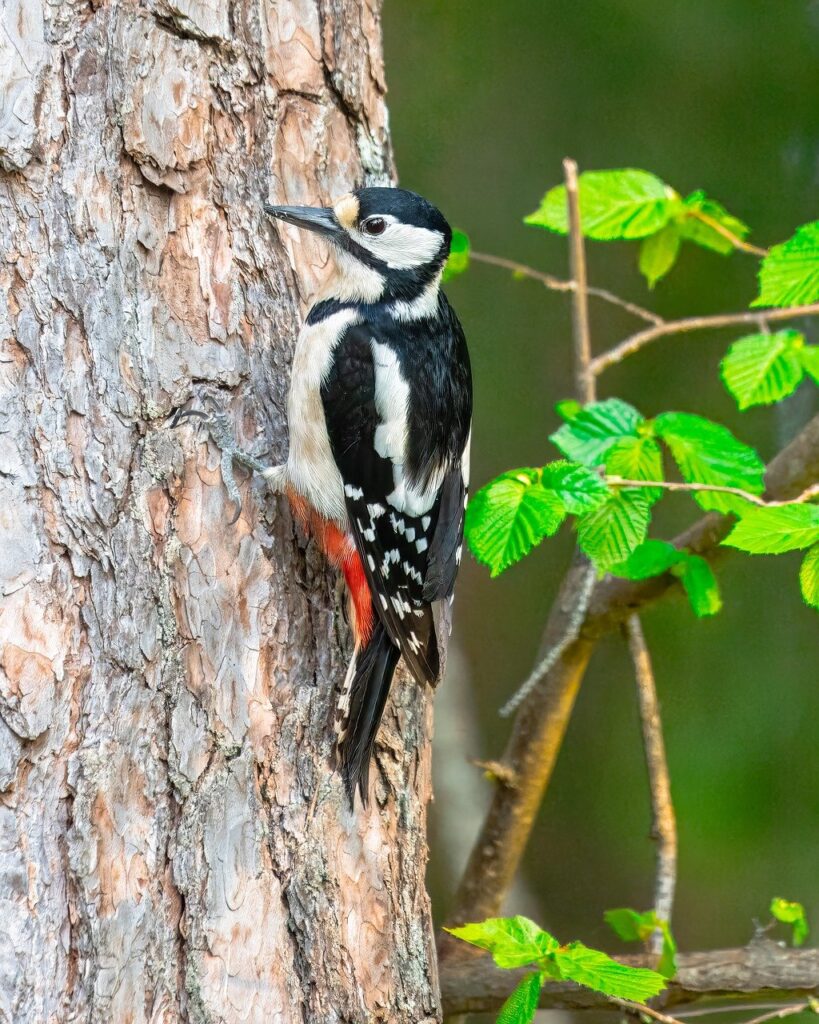
Why Does a Woodpecker Peck Wood?
1. For Food
Woodpeckers love to munch on hidden insects, larvae, and tiny worms living under the bark.
2. For Shelter
They carve out hollow holes in old tree trunks, creating warm and secure nests -perfectly insulated by nature.
3. For Communication
Woodpecker drumming is a message- usually to attract a mate or claim territory.
4. For Sap
Some species drill tiny holes to drink the sap of trees and feast on the insects attracted to it.
Latest Research: Woodpecker Hammering Is a Full-Body Operation
When we think of a woodpecker, we often admire the beak. But new research reveals something surprising:
Pecking is a full-body performance — breath, muscles, posture, everything.
Imagine being told to carve a hollow in a tree trunk with an axe.
How long would it take you?
Now imagine a 25-gram bird exerting forces up to 30× its body weight – not once, but hundreds of times a day.
That’s the kind of biomechanical brilliance scientists have just decoded.
Inside the Study
A recent paper in The Journal of Experimental Biology uncovered just how coordinated this movement really is. Here are some fascinating insights.
- They Breathe Like Athletes
Researchers compared woodpecker pecking to a tennis player’s strike.
Just like a tennis player who exhales with each hit, a woodpecker lets out a deep exhale with every peck.
- Scientists Measured 8 Different Muscles
They inserted electrodes into eight muscles and observed the birds during two activities:
Drilling – for excavating wood
Tapping – for communication
- To capture the full picture,
each bird wore a tiny custom backpack that recorded electrical signals synced to high-speed video.
The result?
A complex choreography of muscles + breath that transforms the woodpecker into a biological hammer.
Their Muscles Work Like Ours but Better
When you use a hammer, your wrist stiffens to reduce energy loss.
Woodpeckers do the same- their neck muscles stiffen right before impact.
But that’s just the beginning.
Other Muscles Joining the Action
Tail Muscles: They brace themselves using tiny tail muscles (like using your core for stability).
Hip Muscle: A single hip muscle controls the power of each strike.
Head & Neck Muscles: These pull the head back after each blow, triggering the next forward motion in a perfect rhythm.
And here’s the jaw-dropper:
They Peck and Exhale 13 Times Per Second
That gives them just 45 milliseconds to inhale between blows.
Yet the timing stays perfectly consistent- no missed beats.
In Awe of the Tiny Hammer of Nature
A bird smaller than your phone, delivering forces 30× its weight, using full-body coordination and athletic breathing… every few milliseconds.
Nature doesn’t just amaze us- it humbles us.
And this is just part one.
Stay tuned for my next post on why woodpeckers are called the “Doctors of the Forest.