

Q1.
Source: CSIR NET Nov 20 Session II
Which one of the statements given below is incorrect?
a. The three common types of membrane lipids are cholesterol, phospholipids, and glycolipids.
b. Phosphoglycerides carry a glycerol backbone, two fatty acid chains, and a phosphorylated alcohol.
c. Most phospholipids and glycolipids form bimolecular sheets rather than micelles in aqueous media.
d. The common alcohol moieties in phosphoglycerides are glycerol, inositol, choline, ethanolamine, and tyrosine.
Correct Answer: d
Understanding the Concept
Biological membranes are composed primarily of amphipathic lipids i.e. molecules that contain both hydrophobic and hydrophilic regions. This property allows them to assemble spontaneously into lipid bilayers, forming the structural basis of cellular membranes.
The major classes of membrane lipids include:
- Phospholipids – the principal structural component of the membrane bilayer
- Glycolipids – important for cell recognition and signaling
- Sterols (e.g., cholesterol) – regulate membrane fluidity and stability
Statement Analysis
a. The three common types of membrane lipids are cholesterol, phospholipids, and glycolipids
Correct.
Cell membranes contain three major lipid classes:
- Phospholipids
- Glycolipids
- Sterols (such as cholesterol)
b. Phosphoglycerides carry a glycerol backbone, two fatty acid chains, and a phosphorylated alcohol
Correct.
Phosphoglycerides (glycerophospholipids) consist of:
- A glycerol backbone
- Two fatty acid chains (hydrophobic tails)
- A phosphate group linked to a polar alcohol head group
c. Most phospholipids and glycolipids form bimolecular sheets rather than micelles in aqueous media
Correct.
Because these lipids possess two bulky hydrophobic tails, they cannot pack efficiently into spherical micelles. Instead, they assemble into bilayers (bimolecular sheets) where:
- Hydrophobic tails face inward
- Hydrophilic heads interact with water
This arrangement minimizes free energy and stabilizes the membrane structure.
d. The common alcohol moieties in phosphoglycerides are glycerol, inositol, choline, ethanolamine, and tyrosine
Incorrect.
Common head groups attached to the phosphate in phosphoglycerides include:
- Choline
- Ethanolamine
- Serine
- Inositol
- Glycerol
These head groups determine the specific phospholipid type (e.g., phosphatidylcholine, phosphatidylserine).
Tyrosine, however, is an amino acid, not an alcohol head group of phosphoglycerides.
Final Answer: d
Q2.
Source– CSIR NET Dec 2019
Which one of the following is not a G-protein coupled receptor?
a. Epinephrine receptor
b. Transferrin receptor
c. Glucagon receptor
d. Thyroid-stimulating hormone receptor
Correct Answer: b. Transferrin receptor
Understanding the Concept
G-protein coupled receptors (GPCRs) represent one of the largest receptor families in eukaryotic cells.
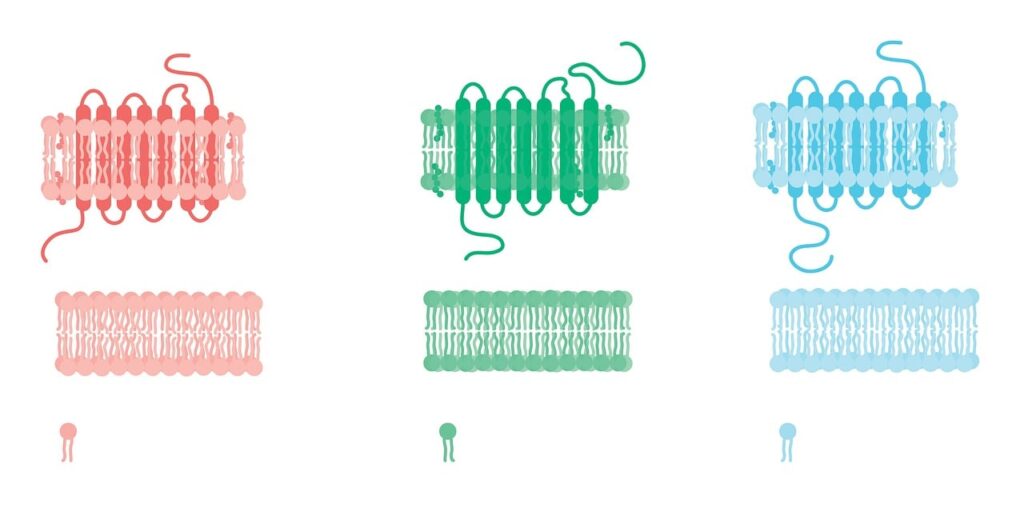
Their defining structural feature is seven transmembrane helices that span the membrane. These receptors:
- Bind extracellular ligands
- Activate heterotrimeric G proteins
- Trigger intracellular signaling cascades
Structurally they contain:
- Three extracellular loops involved in ligand interaction
- Three intracellular loops that interact with G proteins
Option Analysis
Epinephrine receptor
Also known as the adrenergic receptor. These receptors activate G-protein signaling pathways and are classic examples of GPCRs.
Glucagon receptor
A well-known GPCR involved in glucose metabolism through cAMP signaling.
Thyroid-stimulating hormone (TSH) receptor
Another GPCR that activates adenylate cyclase signaling in thyroid cells.
Transferrin receptor
Not a GPCR.
Instead, it is a single-pass transmembrane receptor involved in receptor-mediated endocytosis of iron-bound transferrin.
Final Answer: b. Transferrin receptor
Competitive exams like CSIR NET rarely test isolated facts. They test whether you understand structure, mechanism, and function together.
Two questions.
Two concepts.
One step closer to cracking the exam.