

I recently typed “what medicine… ” and I was shocked by the auto-complete results.
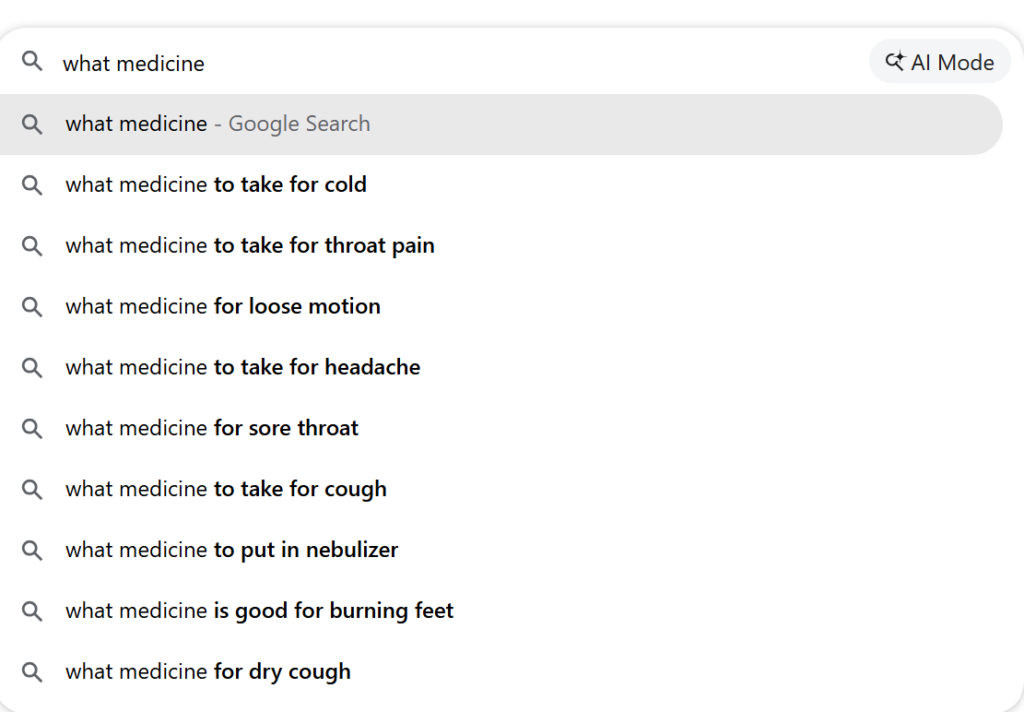
Worried, I tried to dig deeper and looked at keyword search trends. Those results were shocking, too.



Searching medications for common cold and sore throat is reasonable and carries a low risk. While searching for medicines for conditions like UTI, dry cough, burning feet, and Chlamydia sounds like a risky way of self-diagnosis and self-medication. An even more shocking question: How many times should I take cough syrup? A cough syrup is not a fruit juice. The dosage should be decided by a doctor, not Google.
The rise of “Dr. Google”
Let’s say you have a headache. You Google a medicine for a headache and head straight to the pharmacy. You buy the painkiller, and it gives you relief for a few hours. Days later, the same symptoms recur (sometimes stronger). So you do what bought you solace the last time- yes, you go to a pharmacy and buy the same medicines, starting the vicious cycle again.
Now, in some cases, the OTC medications definitely work. They may be something minor like a mild cold or a mild headache. But the actual problem starts when those symptoms appear again after a brief relief from the medications. Symptoms are your body’s way of signaling that something is wrong and that you need to look into it. Most of the time, though, due to work or other reasons, we try to suppress the signal. Repeatedly doing this can result in bigger problems. It may delay diagnosis in some cases.
Symptomatic relief may provide temporary comfort, but it rarely solves the underlying problem. In many cases, it simply masks the real issue.
Hidden risks of repeated self-medication
Repeated self-medication can also place unnecessary strain on your liver, the organ responsible for metabolizing and detoxifying most drugs. In fact, debates around commonly used drugs like acetaminophen (Tylenol) have sparked discussions about long-term safety in certain situations. I explored this topic in detail in my earlier post on the Tylenol–autism controversy, which highlights why even widely used medications should be taken carefully and only when necessary.
All these problems would have been solved if you had headed to a medical professional after your symptoms reoccurred.
The risks do not end here
Tell me honestly-
- Do you complete the full dosage of the medicine as instructed by the pharmacist?
- Do you stop them once the symptoms disappear?
Well, if your answer was No and Yes, then you are paving the way for antimicrobial resistance. Your body may stop responding to antibiotics. This, of course, needs to be followed for self-medication as well as those prescribed by a doctor.
When are OTC meds helpful?
I am not against OTC medications. They can be really helpful in these cases-
- Minor ailments like a cold, cough
- Fever
- Mild headache
- Temporary pain relief
However, when these symptoms reappear and are getting stronger, it is best to seek advice from a qualified professional. Here are a few red flags-
- Symptoms last more than a few days
- Severe pain
- Recurrent symptoms
- Infections
- Chronic conditions like cholesterol
- Symptoms interfere with your daily routine.
There is no one-size-fits-all solution when it comes to healthcare. Each person is different. The medication for a given condition may be the same. But the dosage will vary. It will largely depend on age, weight, medical history, severity of the condition, and most importantly, concomitant drugs (which is why doctors ask if you are on certain medications before starting your treatment).
Case Study: When “Harmless” OTC Drugs Become Dangerous
This case highlights a dangerous misconception: availability without prescription does not mean complete safety.
A recent case report described a patient who developed severe hypokalaemia (dangerously low potassium levels) after repeatedly using OTC medications without proper medical supervision. The patient assumed that because the drugs were available without a prescription, they were completely safe. However, prolonged use eventually caused a serious electrolyte imbalance that required urgent treatment.
Some real numbers
Studies show that self-medication is extremely common. In some populations, rates can range from 12% to 90% depending on the population studied. And it can be in the higher range especially in places where over-the-counter medicines are easily available.
While OTC drugs are designed to treat minor ailments safely when used correctly, misuse is a growing global concern. Research has linked inappropriate use to adverse drug reactions, hospitalisation, and delayed diagnosis of underlying diseases.
I am not against OTC medications. In fact, Over-the-counter medicines are an important part of modern healthcare and can offer quick relief for minor ailments. However, convenience should never replace caution. When symptoms persist, worsen, or keep returning, they may be your body’s way of asking for professional help.
Use OTC medicines wisely. But remember, Google is not a doctor, and self-diagnosis is not a substitute for proper medical advice.
Stay Happy, Stay Healthy!