

A biosensor is an analytical device. It can detect the amounts (quantitative) of biological substances, known as analytes. These analytes may include metabolites such as glucose and urea, enzymes, nucleic acids, or other biomolecules.
Key Components of a Biosensor
- Bioreceptor
The bioreceptor is the biological recognition element of the biosensor. It specifically interacts with the target analyte. Common bioreceptors include enzymes, antibodies, nucleic acids, microorganisms, and whole cells.
- Transducer
The transducer converts the biorecognition event into a measurable signal. Depending on the mode of detection, the signal may be electrochemical, optical, piezoelectric, or thermal.
- Signal Processor
The signal processor amplifies and processes the transducer output and converts it into a readable form, such as an electrical signal or digital display.
Working Principle of a Biosensor
The biorecognition element, such as an enzyme, antibody, or nucleic acid, is immobilized onto the sensor surface using conventional methods, including covalent or non-covalent binding. This biological component is positioned close to the transducer.
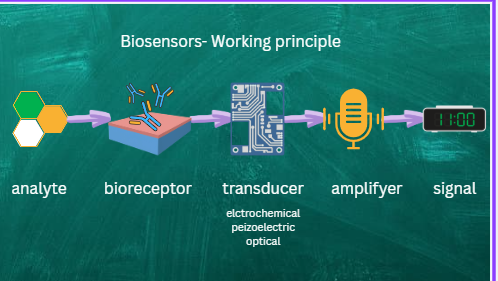
When the target analyte interacts with the bioreceptor, a specific biochemical reaction occurs. This interaction leads to measurable changes such as the transfer of electrons, the generation of ions or gases, or the release or absorption of heat. The transducer detects these changes and converts them into a corresponding electrical or optical signal. The signal is then amplified, processed, and quantitatively measured, with its magnitude being proportional to the analyte concentration.
- Sensor Platform / Electrode System
The sensor platform provides a solid support for the immobilization of the bioreceptor and facilitates interaction with the analyte. In electrochemical biosensors, this typically consists of a working electrode, a reference electrode, and a counter electrode. The bioreceptor is immobilized on the working electrode, where the biochemical reaction occurs.
- Immobilization Matrix
The immobilization matrix anchors the bioreceptor onto the sensor surface while retaining its biological activity. Common matrices include polymers, gels, membranes, or nanomaterials. Proper immobilization improves sensor stability, sensitivity, and reusability.
- Transducer Unit
The transducer is positioned in close contact with the bioreceptor and converts the biochemical event into a measurable signal. Depending on the sensor type, the transducer may detect changes in current, potential, light intensity, mass, or temperature.
- Signal Conditioning and Processing Electronics
The raw signal generated by the transducer is often weak and noisy. Signal conditioning circuits amplify, filter, and convert this signal into a usable form. Analog-to-digital converters (ADCs) translate analog signals into digital data for further processing.
- Display and Data Acquisition System
The processed signal is displayed as a numerical value, graph, or trend using a digital display or computer interface. Modern biosensors may also include data storage, wireless transmission, and real-time monitoring capabilities.
Electrochemical devices such as pH meters operate on similar instrumentation principles, with electrode systems and signal processing units forming the core of measurement.
Types of Biosensors
- Electrochemical Biosensors are based on biochemical reactions that involve the generation or consumption of electrons or ions. The resulting changes in current, potential, or impedance are measured and correlated with the analyte concentration.
- Optical Biosensors use light-based detection methods to monitor biorecognition events. These methods include fluorescence, absorbance, and surface plasmon resonance, where changes in optical properties indicate analyte binding.
- Piezoelectric Biosensors detect changes in mass at the sensor surface upon analyte binding. The mass change alters the resonant frequency of a piezoelectric crystal, which is measured and related to analyte concentration.
- Whole-Cell Biosensors utilize living microbial or mammalian cells as the biorecognition element. The cellular response to a specific analyte, such as changes in metabolism, respiration, or gene expression, is measured as a detectable signal.
Applications of Biosensors
- Blood Glucose Measurement is one of the most widely used applications of biosensors. Devices such as conventional glucose meters and continuous glucose monitoring (CGM) systems detect glucose levels in blood or interstitial fluid and convert the biochemical response into a measurable signal displayed as a numerical value. Similar biosensor principles are applied in the detection of other disease-related biomarkers. For example, Prostate Specific Antigen (PSA) is commonly measured as a diagnostic marker for prostate cancer.
- Bioprocess Technology: In industrial-scale processes such as fermentation and metabolic engineering, biosensors are used to monitor key metabolites, including glucose, lactate, and ethanol. Real-time measurement of these parameters helps assess the physiological state of the culture and optimize process control.
- Environmental Monitoring: Biosensors play an important role in environmental monitoring by enabling the detection of pollutants, pesticides, and heavy metals in water, soil, and air samples. Their rapid response and high specificity make them suitable for on-site analysis.
- Food and Pharmaceutical Safety: Biosensors are extensively used in the food and pharmaceutical industries for the rapid detection of toxins, pathogens, and contaminants. They help ensure product quality, safety, and regulatory compliance.
Limitations of Biosensors
- Limited Stability of Bioreceptors: Biological components such as enzymes and antibodies may lose activity over time due to temperature, pH fluctuations, or chemical denaturation, which can affect sensor reliability and shelf life.
- Interference from Non-Target Substance: Complex sample matrices may contain interfering species that produce non-specific signals, reducing the selectivity and accuracy of the biosensor.
- Need for Frequent Calibration: Many biosensors require regular calibration to maintain accuracy, especially during long-term or continuous measurements.
- Restricted Operating Condition: Biosensors often function optimally only within narrow ranges of pH, temperature, and ionic strength, limiting their applicability under harsh environmental or industrial conditions.
- High Production and Development Costs: The fabrication of biosensors, particularly those involving nanomaterials or advanced transducers, can be expensive.
- Limited Reusability: Some biosensors are designed for single use, as repeated exposure to analytes or cleaning procedures may degrade the bioreceptor or sensor surface.
If this post on biosensors was helpful, see if you can answer this:
You are designing a biosensor to detect a specific environmental pollutant in water. Which type of biosensor would you select and why? Justify your choice based on sensitivity, specificity, instrumentation requirements, and practical feasibility.
Comment your answers below.
Interesting read, thanks for sharing